Ravenloft
The Peculiar History of the Kingdom of Barovia, Part 1
No sound? On iPhone and iPad, read-aloud follows the silent switch — turn silent mode off to hear it.
The Peculiar History of the Kingdom of Barovia.
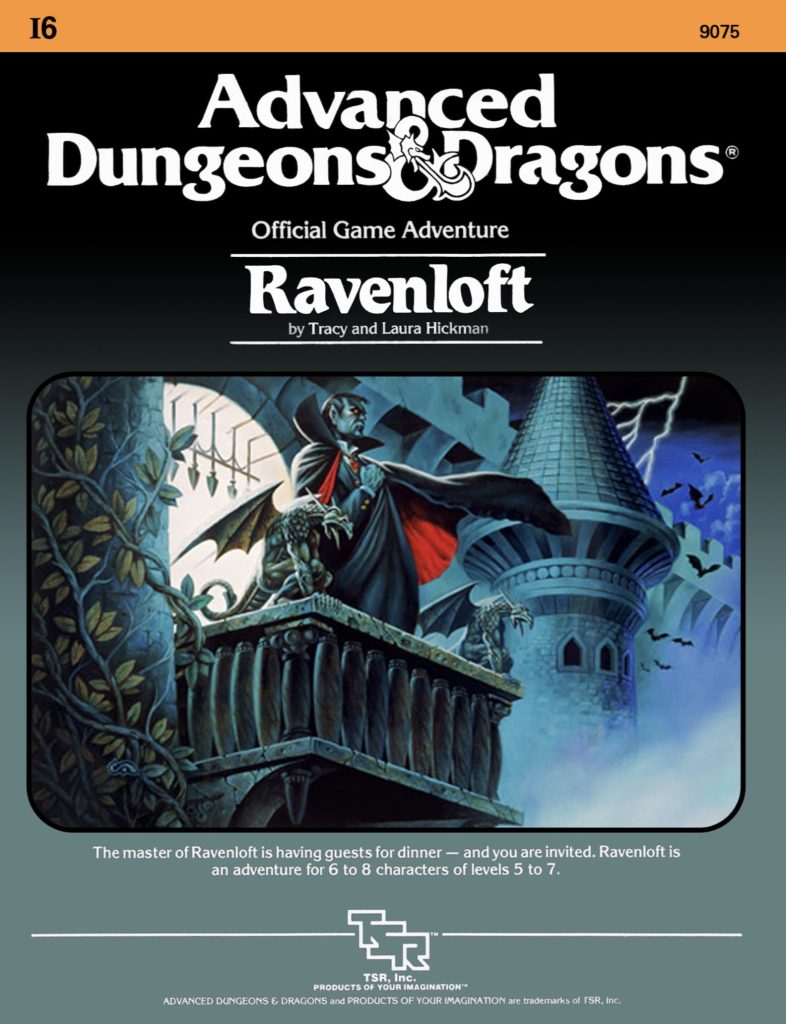
I6 Ravenloft, written by Tracy and Laura Hickman and published by TSR in 1983, is one of the most celebrated adventure modules in the history of Dungeons and Dragons. More than forty years on it is still played, still discussed, still analysed in dedicated groups, and still regarded by many as a benchmark for horror adventure design. The Hickmans built something extraordinary: a horror-tragedy with a consistent internal logic, a richly implied history, and a central character of genuine psychological complexity. The names alone are phonetic constructions of considerable craft. Strahd, Barov, Sergei, Tatyana, Ciril, Pidlwik: most encode meaning that rewards close reading.
Over time, I6 was extended by a series of publications: the Realm of Terror boxset (1990), Vampire of the Mists (1991), I, Strahd (1993), and others. Each worked primarily from its immediate predecessor rather than returning to I6 itself. The result is that Strahd and the setting most players encounter today differ substantially from what I6 actually contains. The conventional portrait of Strahd as a tragic fallen hero, condemned by dark powers and suffering for sins committed in passion, is not in I6. The demiplane that has become the defining feature of the Ravenloft setting is not in I6. Several specific details of Strahd's history and the people around him that subsequent publications treated as established fact are inferences or interpolations from later sources rather than from the original.
This piece goes back to I6 and to Christie Golden's Vampire of the Mists, the most careful engagement with the original material in the subsequent canon. It asks what the evidence actually establishes, what it leaves open, and what the alternative readings are when the evidence is examined carefully. Claims are separated throughout into what the sources establish, what they make plausible, and what remains speculative reconstruction. Where something is inference, it is identified as such.
Why Strahd's Account Cannot Be Taken at Face Value
This needs to be established before anything else, because it underpins everything that follows.
When Jander Sunstar reads the Tome of Strahd in VotM, Christie Golden does not leave the reader in any doubt about what they are looking at: "This was no chronicle of the past. This was Strahd's propaganda, his writing of history as he wanted to see it, just like the tale, riddled with falsehoods, that he had told Jander years before about how Barovia had entered the mists" (VotM, Chapter 19). Golden also pinpoints the exact moment deception becomes part of Strahd's nature. Immediately after murdering Sergei and framing an unknown assassin: "Strahd was astounded. It had been so easy. He had never lied before… He wondered if this easy way with falsehood was yet another part of his dark gift" (VotM, Chapter 21).
This is not subtext. Golden is telling the reader explicitly that Strahd lies, that everything he writes is suspect, and that his facility with falsehood begins at the moment of the murder. The lying is the natural extension of who he already was, not something the transformation created. Any source that relies on his account uncritically inherits that unreliability. This includes the Tome of Strahd in both I6 and VotM, the RoT summary of his history, and I, Strahd by P.N. Elrod, written entirely from his first-person perspective.
One distinction matters here. VotM's prologue and Jander's direct observations are independent of Strahd's testimony: they predate his arrival or record what Jander sees with his own eyes. But VotM is not independent of later Ravenloft development. Golden wrote with I6 and the RoT boxset as references and under TSR guidelines. The reason to trust her prologue over Elrod's elaborations is not that she stands outside the canon but that she works more carefully with I6's underlying texture, and that her prologue in particular predates any of Strahd's influence within the fiction. That distinction is worth keeping clear.
The older journal Jander also discovers predates the transformation and was written in real time. It is more reliable on specific facts than the Tome, since it is Strahd recording events as they happen rather than rewriting them in retrospect. But it remains his perspective, coloured by bitterness and vanity. It covers only the final two years before the transformation, and what it tells us about his earlier life amounts to what he chose to record about himself in those two years.
What I6 and VotM's prologue give us that is most independent of Strahd: the crypt inscriptions, the physical evidence of the castle, the events of the prologue, and Jander's direct observations.
The Court Before Strahd
The castle predates Strahd by a considerable margin. I6's crypts record rulers and builders long before the Von Zarovich family. A King Endorovich the Terrible had his keep built by Artimus using slave labour (I6, Crypts 7 and 19), and other kings followed in sequence. By the time of the prologue the castle has been the seat of the Von Zarovich family for at least a generation. VotM's prologue opens there before Strahd has arrived, before his name is attached to the building. Golden does not call it Castle Ravenloft. At this point it has no such name. Strahd later claims in his journal to have named it in honour of his mother (VotM, older journal, Year 349), but that is his journal and his claim. The castle may have carried Ravenovia's name already, or been named after Barov (who, as we will discuss, Strahd conspicuously never mentions), or been named by an earlier king entirely. What the sources establish is only that it was unnamed during the prologue and named by the time the older journal was written. How it came to be named is Strahd's account alone.
I6's K88 records the "Tomb of Barov and Ravenovia," and Crypt 30 identifies Ciril Romulich as "Beloved of King Barov and Queen Raven, High Priest of the Most Holy Order." These are the only direct I6 references to the king and queen. I6 names her as Queen Raven, the source of the castle's eventual name, whatever the truth of who bestowed it. The full form Ravenovia comes from K88. The Realm of Terror gives her the surname Van Roeyen (RoT, p.127), which does not appear in I6 and derives from Strahd's own account as summarised in RoT. There is no obvious reason for Strahd to have invented a mother's family name, and it may well be accurate, but it rests on his say-so.
The crypt record allows a partial reconstruction of who constituted the court. These are not a random collection of names. The people buried in these crypts were the king's closest circle, and the epitaphs tell us something about each of them and how they related.
Stephan Gregorovich (Crypt 25) was "First Counsellor to King Barov." The inscription as it stands contains a typesetter's error rendering "Barov" as "Baron," but the context is clear. His epitaph places him close to Barov in the political hierarchy: the man the king trusted with counsel and the conduct of the kingdom's affairs. Khazan (Crypt 15), whose epitaph reads "His word was power," was the court wizard. The terse epitaph and burial placement speak to his standing, though how his role functioned in practice I6 does not detail. Ciril Romulich (Crypt 30) was "Beloved of King Barov and Queen Raven," not merely employed but beloved, a word the Hickmans used deliberately. VotM's prologue confirms his standing: the household was instructed to obey him in all things while the master was away (VotM, prologue). In a court where the king is absent, that instruction made the priest the functional head of the household.
Counsellor, wizard, priest: these three constitute the inner circle of a functioning royal court. Their presence indicates a court sophisticated enough to maintain this full complement of advisors, with relationships close enough that Ciril's epitaph records genuine personal affection on both the king's and queen's part. That Ravenovia is named alongside Barov in the epitaph is worth noting. She was a presence in the household in her own right, not merely a consort.
Also interred in the crypts are Dorfniya Dilisnya (Crypt 8) and Pidlwik (Crypt 9), and Elsa Fallona (Crypt 16). Dorfniya's burial among the royal dead requires explanation. She bears the Dilisnya name rather than the Von Zarovich title, and she holds the rank of duchess. A duchess buried in the royal crypts alongside kings and their closest advisors is most plausibly a woman of royal birth who did not stand in the direct line of succession. One suggestive reading, though it rests on linguistic analogy rather than textual proof, is that "Von Zarovich" functions as a dynastic designation rather than a surname. "Zarovich" derives from "Zar" (the Slavic cognate of Tsar) combined with the patronymic "-ovich," meaning "descended from." These are coherent and suggestive readings, but readings from linguistic analogy and naming pattern, not from explicit textual evidence. They are noted here as such.
What the evidence does establish more solidly is the court function implied by Dorfniya's fool. Pidlwik (Crypt 9) is identified by function rather than family designation. "Fool of Dorfniya" foregrounds his role rather than locating him in a family line. The court jester's historical function was the socially licensed delivery of truths that no counsellor could safely speak to power directly. Whatever Dorfniya's precise relationship to the ruling line, the presence of a personal fool buried in the royal crypts suggests a woman of sufficient standing that her instrument of indirect speech was considered worth preserving alongside the great.
Elsa Fallona (Crypt 16) is recorded by name alone, with no epitaph, no dates, and no stated relationship. I6 tells us nothing about her beyond the fact that she mattered enough to be interred here.
There is one figure conspicuous by absence. Strahd weeps in Sergei's crypt (I6). He visits Ravenovia's tomb in a frenzy of rage (I6, K88). He records Sergei's arrival and their growing relationship with evident feeling (VotM, older journal, Year 350). But Barov, the king, the man who built this court and whose throne Strahd returned to claim, is never mentioned. Not in grief, not in anger, not in memory, not once in any account Strahd gives of himself. In someone whose emotional responses to the dead are so vividly documented elsewhere, this silence is not nothing.
The Collapse of the Court: Possible Readings
The Realm of Terror family tree Note A states that "all deaths in 351 occurred at Castle Ravenloft, the day of Tatyana's wedding" (RoT, p.123). This covers the Dilisnya massacre of the wedding day. It does not cover the deaths that preceded Strahd's arrival. Barov and Ravenovia are recorded as dying the year before he returned (RoT, p.127), and the crypt positions of Stephan Gregorovich, Khazan, Dorfniya, Pidlwik, and Elsa Fallona suggest they died in the same general period: the year of the goblin attacks, before Strahd arrived. The entire inner circle of the court died in a single year while the castle itself still stood.
VotM's prologue confirms the goblin attacks were real and intensifying. Ciril was neglecting his ordinary duties to complete the Holy Symbol because the situation had become so severe (VotM, prologue). The castle household was frightened. The master was away.
The most straightforward reading is that these deaths were casualties of the goblin siege. This is consistent with the sources, and the prologue supports a picture of genuine and escalating threat.
A second reading is possible and worth examining, though it cannot be confirmed from the sources. VotM's prologue states "the master of the castle had left for war" immediately before Strahd's arrival (VotM, prologue). But Sturm's crypt in I6 is completely empty (I6, K85 area), and VotM confirms he lived out his entire life away from Castle Ravenloft (VotM, Chapter 25). A man who escaped during a massacre and a man who left before the crisis in deliberate flight produce the same physical record: an empty crypt, a life lived entirely elsewhere. Under this reading the goblin attacks provide cover for deaths that had a different cause.
Both readings are consistent with the physical evidence. Neither can be confirmed. The emotional evidence from I6, above all Strahd's rage at Ravenovia's tomb and his complete silence about Barov, fits the second reading somewhat more precisely than the first. Rage at a tomb is the response of someone who feels refused or denied something rather than simply bereft. The sources do not resolve this.
Strahd's Absence: Possible Readings
I6 contains no account of why Strahd left the castle, how old he was, how long he was away, or what he did. The Tome of Strahd provides no pre-vampire history at all. The only accounts of his early life come from I, Strahd (Elrod, 1993) and from RoT's summary, both of which trace back to Strahd's own account. The "age 14, thirty years of honourable military service" narrative is entirely his own (I, Strahd; RoT, pp.116–117).
What the primary sources establish independently is a single significant fact: by the time Strahd returned he had been absent long enough that his youngest brother, who grew up in the same castle, had never once met him. "My youngest brother whom I have never before met" (VotM, older journal, Year 350). This is not a few years' campaign. This is an absence through Sergei's entire childhood and young manhood, through the deaths of his parents, through a sustained military crisis in the valley itself.
Three possible readings of that absence present themselves.
The first is the conventional account: honourable military service, a dutiful firstborn away at his ancestral war. This is Strahd's own account. It cannot explain comfortably why a man who weeps at his brother's tomb and rages at his mother's made no recorded attempt to return through any of it.
The second reading is suggested by a piece of evidence that deserves more attention. On the morning of the murder, Strahd presents Sergei with a Ba'al Verzi assassin's dagger as a wedding gift, describing it with the ease of long familiarity: "the time-honored weapon of the Ba'al Verzi assassin," its sheath "made of human skin, usually from the weapon's first victim," its hilt "runes of power" (VotM, older journal, Year 351). The dagger was already in Strahd's possession. He produced it for the occasion and has clearly owned it for a long time.
The conventional reading treats this as a trophy from a failed assassination attempt. But the dagger reads more convincingly as a guild credential than as a trophy. Its sheath is made from the skin of its owner's first victim, and Strahd has one. A trophy is displayed. A professional credential is kept close and used when needed. Strahd kept this one for a very long time and used it, ultimately, on his brother. The most coherent reconstruction is that Strahd committed a killing at some point that made his continued presence at the castle impossible, found employment with the Ba'al Verzi over the years of his absence, and returned when the people who knew why he left were dead or silent. That is not established. It is the reading the physical evidence best supports, independent of Strahd's own account of himself.
A third possibility is that Strahd was sent away in disgrace for something less irreversible than a killing. It does not, however, explain the Ba'al Verzi dagger. Of the three readings, the second fits the available evidence most coherently.
The Return: Possible Readings
VotM's older journal places Strahd's arrival at the end of a military campaign: "Twelfth Moon, 347: At long last, the war is over. The enemy has been decimated, destroyed, or driven out. I have found a valley that lies before the ruins of the war-lord's castle. I have taken both…" (VotM, older journal, Year 347). Strahd came to a valley he grew up in and calls it found. Whether that language reflects genuine emotional distance or the rhetorical posture of a man performing the role of conqueror, the text does not resolve.
The conventional reading has Strahd returning as a conquering hero after long service, finding his family dead from goblin attacks, and claiming the valley that had always been his birthright. The emotional record argues against it. A man who arrived to find his family killed by goblins might have something to say about his father. He might grieve him, invoke him, name him once. Strahd says nothing. Barov is absent from every account Strahd gives of himself, every journal entry, every conversation recorded in any source. He weeps for Sergei and rages at Ravenovia. Barov is simply not there.
After the Return: Sergei, Kir, and Tatyana
What follows is the strongest reconstruction the evidence permits. It should be read as such.
However the return unfolded, the castle was empty of everyone who had known Strahd before. His own journal records the result: "no family, no intimate friends" (VotM, older journal, Year 350). He wanted his youth back. He wanted to be Sergei (VotM, older journal, Year 350).
Sergei arrived to meet a brother he had never known. The older journal records genuine warmth on Strahd's part: admiration for his brother's fighting skill, pleasure in his company, something that functioned like fraternal affection beneath the jealousy. He had the castle. He was alone in it. Then Sergei arrived, skilled and innocent and knowing nothing of what his brother was, and for a time Strahd tried to hold back whatever in him was incapable of allowing things to last.
Then Sergei, doing parish work in the village, met Tatyana and fell in love with her.
Kir, the High Priest, died suddenly not long afterward. The older journal records it in a single flat sentence with no explanation (VotM, older journal, Year 350). The strongest speculative reconstruction is that it was not unremarkable. A fully ordained priest cannot marry. With Kir dead and Sergei as his designated successor within the church, the expectation would be for Sergei to take full holy orders, removing him cleanly as a rival for Tatyana without any violence between brothers. The timing of Kir's death, precisely when Sergei's relationship with Tatyana was becoming serious, makes this reconstruction coherent. Strahd's Ba'al Verzi credentials make the means available. The argument is not proven by the sources. It is the reading that best fits the sequence and that gains support from what Strahd says over his brother's body afterward.
Whether or not Strahd killed Kir, the murder achieved one further consequence: it eliminated the one other person who fully understood what the pendant around Sergei's neck actually was. VotM's prologue establishes that Ciril had crafted the Holy Symbol of Ravenkind and passed its secret to Kir (VotM, prologue). Kir had used it once in secret against the goblin king, then hidden it carefully (VotM, Chapter 13). The pendant had passed to Sergei on Kir's death as his designated successor. Strahd dismissed it as "the Priest's Pendant, a pretty enough bauble to which Sergei attaches a great deal of, perhaps too much, emotional value" (VotM, older journal, Year 350). The secret had died with Kir. The most powerful weapon in the valley hung around his brother's neck and Strahd never knew it.
The Ba'al Verzi dagger was presented to Sergei as a wedding gift on the morning of the murder, its history explained with the casual authority of long ownership (VotM, older journal, Year 351). The words Strahd spoke over his brother's body were "you were supposed to have been a priest" (VotM, older journal, Year 351). Not grief. The fury of a man who had, on the strongest reconstruction, already killed someone else to engineer a different outcome, and who had been forced to fratricide anyway by a love he had failed to grasp was absolute.
Barovia After 351
The records of who survived the events at the castle are records Strahd controlled. I6 shows the endpoint of the centuries that followed: a village in terminal decline, most houses abandoned, most shops closed, a population diminished to a fraction of what it must once have been (I6, Village of Barovia).
On the question of what Barovia is: I6 does not require Barovia to be read as a demiplane, and does not supply the cosmological machinery that made that reading standard. In I6, Barovia is a land, a valley, a castle, a vampire who has ruled for a very long time, and the isolation of its people is a fact of the fiction without a cosmological explanation attached. The Realm of Terror introduced the demiplane framework and the language of dark powers and condemned lords, which positions Strahd as a victim of forces beyond his control as much as a perpetrator. That framework is not in I6. The isolation is a fact of the setting, and the source of that isolation in I6 is Strahd's will. Whatever later publications built on top of that, the original horror does not depend on cosmic machinery. It depends on a man who chose to seal a valley and has never stopped choosing it.
The Holy Symbol hung forgotten around Sergei's neck in a crypt prepared but never properly used. The brother was murdered, the grave was made, the body never properly interred, the pendant never removed. The most powerful weapon in Barovia lay a few hundred feet from where Strahd slept, unrecognised by everyone including him, for centuries.
Strahd as Written
Jander Sunstar arrived through the mist and is the first figure the sources show observing Strahd from outside his control in a sustained way. Christie Golden, writing through Jander's eyes, gave readers the one sustained independent account of Strahd and his land that exists in the Ravenloft canon.
What Jander found was not a tormented lord in a prison. It was a man settled in his dominion: intelligent, patient, cultivated, dangerous, entirely invested in this place (VotM). The village folk called him the devil Strahd not merely because of what he was, but because centuries of rule had made his character legible even to those who could not fully name it.
Jander found the Tome and recognised it as propaganda. He found the older journal and learned the final sequence. He found the headless statue in the Hall of Heroes, the one figure deliberately destroyed, the one name Strahd specifically prevented Jander from examining (VotM). He found the wedding room untouched in its decay: the rotting cake, the portrait with the groom's face slashed through repeatedly, and Tatyana's face looking up at the faceless man with absolute joy. He found the pendant around Sergei's neck in the prepared but unused crypt.
He used it, called on Lathander, offered everything he had. The light nearly finished Strahd. Then the beam broke and Strahd escaped. Jander collapsed, his hand nothing but blackened bone. He survived the night only long enough to choose the dawn rather than remain in Barovia. It was not enough. That is what I6 is about.
The conventional Strahd, accumulated across thirty years of publications, is a tragic figure. He was good once. He fell through passion and despair. He suffers for what he did. Dark forces condemned him.
The Strahd who emerges from the primary sources is different. He was absent long enough that his youngest brother never knew him. He returned in possession of what reads most convincingly as an assassin's guild credential. He arrived at a castle where the entire ruling circle had died under circumstances a goblin siege conveniently obscured. His father is never mentioned, not in grief, not in memory, not once. He killed Kir to force Sergei into ordination and thereby remove him as a rival for Tatyana, a path that would have cost neither brother his life. He was defeated when Sergei refused ordination entirely and chose Tatyana anyway, leaving no path that did not end in murder. He sealed his valley and has ruled it ever since.
Strahd visits his mother's tomb in a frenzy of rage (I6). He weeps in his brother's crypt (I6). He has slashed the groom's face from the wedding portrait so many times the features are gone (VotM). These things are consistent with a man capable of something that functions like attachment, who responds to the objects of that attachment with rage and destruction when they are lost or withheld. Not tragedy. Not cosmic punishment. A man whose darkness is not the product of circumstance but of what he fundamentally is, documented across four hundred years of consistent behaviour.
That Strahd is more frightening than the conventional version. He is frightening precisely because there is nothing to mitigate him. There is a man who took a land and sealed it, and the people inside it have nowhere to go. That is what the Hickmans built. It is still there in I6, waiting to be read.
A Note on the Calendar
The Realm of Terror places the events of I6 at year 528, with Strahd's transformation at year 351. I6 itself states Strahd has been draining the land "for over 400 years" if the players fail, and "after 500 years" Tatyana and Sergei are reunited if the players succeed (I6, pp.4 and 30). At year 528 Strahd has been a vampire for 177 years, nowhere near 400. The dates are incompatible with the module. The birth years in the family trees (Barov 277, Strahd 306, Sergei 324) are inferences built on that incorrect foundation and should be treated as a rough guide to relative ages and sequence only. No calendar is used in this piece.
Conclusion
The history of Barovia as I6 actually presents it is darker and more coherent than the accumulated conventional account. The court before Strahd was a functioning royal household: a king and queen whose names survive in stone, a first counsellor trusted with the kingdom's affairs, a wizard whose word was power, a priest beloved of both, a duchess whose burial in the royal crypts speaks to exceptionally high standing. Its collapse occurred in the period of the goblin attacks, under circumstances that may have been entirely external or may have been shaped by Strahd's return. The sources support both readings.
Strahd's absence is documented only by himself and those elaborating his account. The Ba'al Verzi dagger, evidence whose existence is harder to dismiss than Strahd's account of his own motives, fits most coherently with the reading that Strahd was exiled following a killing and spent part of his absence in the service of the Ba'al Verzi, returning when the people who knew why he left were gone. His return was either a homecoming or a demand for the throne. The emotional record argues more strongly for the second. Kir's sudden death was either unremarkable background or Strahd's attempt to save Sergei by engineering his ordination. The sequence of events and what Strahd says over Sergei's body argue more strongly for the second. Barov's total absence from every account Strahd gives of himself remains either oversight or something the sources cannot explain.
None of these questions are resolved by the sources. All of them are worth asking. I6 does not require Barovia to be read as a demiplane, and does not provide the cosmological machinery that made that reading standard. Strahd is not a condemned prisoner. He is a man who sealed a land because he chose to, and who stays because everything that matters to him is there. The fog is his tool. The isolation is his policy. The centuries of decline are his consequence.
The Hickmans do not receive anywhere near the credit they deserve for what they built. The original I6 is a carefully constructed, internally consistent horror-tragedy that did not need embellishment. Going back to what it actually contains clarifies many of the contradictions that thirty years of expansion introduced. The source was stronger than its successors allowed. It still is.
This is Part 1 of a two-part series. Continue to Part 2: The Peculiar History of the Kingdom of Barovia.
Bibliography
- I6 Ravenloft, Tracy and Laura Hickman, TSR Inc., 1983.
- Vampire of the Mists, Christie Golden, TSR Inc., 1991.
- Realm of Terror (Ravenloft Campaign Setting), Bruce Nesmith with Andria Hayday, TSR Inc., 1990.
- I, Strahd: The Memoirs of a Vampire, P.N. Elrod, TSR Inc., 1993.
Comments