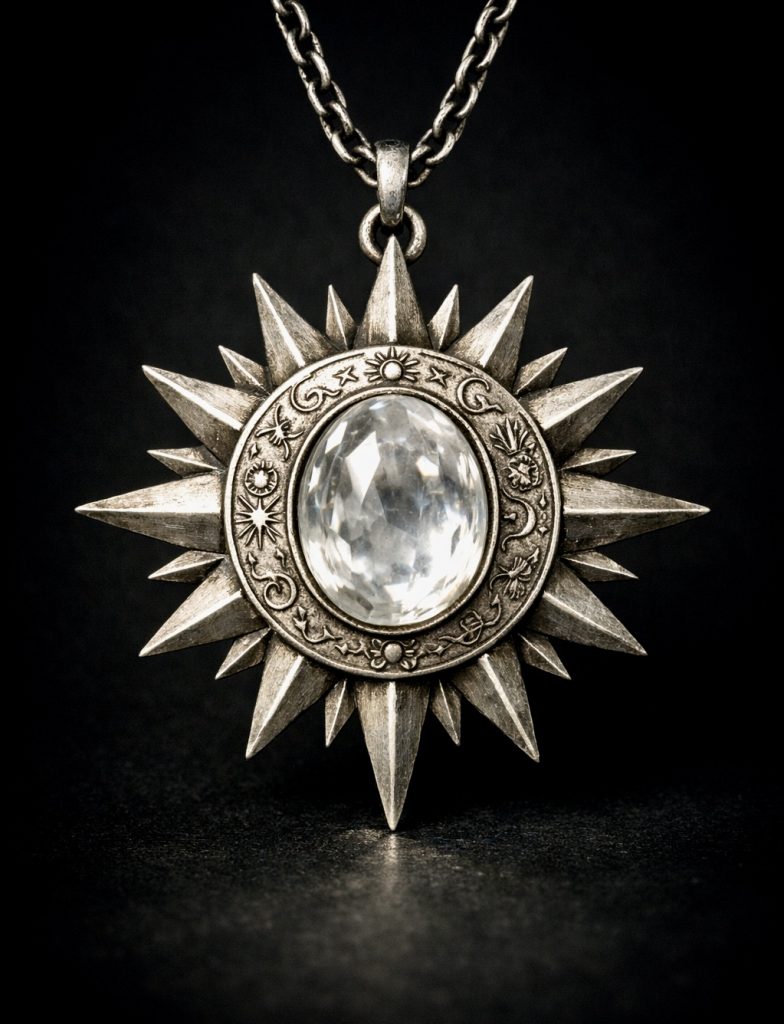
Much of what has been published about the origin of the Holy Symbol of Ravenkind since 1991 contradicts the primary sources.
Later editions have replaced the original account with invented backstories. The true origin of the Holy Symbol is laid out in the prologue of Christie Golden’s Vampire of the Mists, the first Ravenloft novel, which works directly from I6 and the Realm of Terror boxset. What she produced was one of the finest pieces of Ravenloft fiction ever written. Its prologue is an extraordinary piece of source material: vivid, detailed, and entirely untouched by Strahd’s influence.
That last point matters more than it might seem. Almost every other account of Barovian history passes through the filter of its most unreliable narrator, the vampire himself. The Tome of Strahd is his own writing. I, Strahd by P.N. Elrod is an elaboration of the same perspective. The prologue of VotM predates all of Strahd’s deceptions. It is, in effect, ground truth.
This article reconstructs the history of the Holy Symbol’s creation from that prologue, cross-referenced against I6 and the Realm of Terror boxset, and makes the case for why later retellings should be set aside.
Why Strahd Cannot Be Trusted
Before examining the prologue, this needs to be established firmly, because it underpins everything that follows.
When Jander Sunstar reads the Tome of Strahd in VotM, Christie Golden does not leave the reader in any doubt about what they are looking at:
This was no chronicle of the past. This was Strahd’s propaganda, his writing of history as he wanted to see it, just like the tale, riddled with falsehoods, that he had told Jander years before about how Barovia had entered the mists. (VotM, Chapter 19)
Jander also discovers an older journal, predating the transformation. It is more revealing, but still Strahd’s perspective, still coloured by his bitterness and vanity. And Golden pinpoints the exact moment deception becomes part of Strahd’s nature. Immediately after murdering Sergei and blaming it on an unknown assassin: “Strahd was astounded. It had been so easy. He had never lied before… He wondered if this easy way with falsehood was yet another part of his dark gift” (VotM, Chapter 21).
This is not subtext. Golden is telling the reader, explicitly, that Strahd lies and that everything he writes is suspect. Any source that relies on Strahd’s own account, including the Tome, I, Strahd, and any later product that draws from them uncritically, inherits that unreliability. The prologue does not. It stands apart.
The Castle Before Strahd
The prologue opens with the last rays of the dying sun filtering through the stained glass windows of “the castle’s chapel.” Not Castle Ravenloft, just the castle. Golden does not name it, and I think this is deliberate. At the time of the prologue, Strahd has not yet arrived.
According to I6, the castle was built by or for King Endorovich the Terrible, the work orchestrated by Artimus, builder of the keep, using an army of slaves (I6, Crypts 7 and 19). It has changed hands since, and by the time of the prologue, the king is dead. The castle could have been called Castle Artimus, Castle Endor, or something else entirely. Barov could have named it after his wife, or after himself. Strahd claims in his journal to have named it “in honor of my mother” (VotM, “Third Moon, 349”), but that is Strahd’s journal, and we have just established what that is worth.
Even the queen’s name is unsettled. I6’s Crypt 30 says “Queen Raven,” while Room K88 says “Tomb of Barov and Ravenovia.” VotM uses “Ravenovia” consistently. The I6 appendix entry for the Holy Symbol also calls its creator “the High Priest of Ravenloft,” while VotM’s prologue calls him “The Most High Priest of Barovia.” I6 is not perfectly consistent in how it names either the queen or the castle, which makes Strahd’s tidy story about bestowing the castle’s name harder to accept at face value.
The prologue also tells us that “the master of the castle had left for war,” leaving instructions that the priest was to be obeyed in all things. With Barov and the Queen dead, this absent lord is most likely Sturm von Zarovich, Strahd’s middle brother and next in the line of succession. VotM later confirms that Sturm’s crypt in Castle Ravenloft was completely empty: “The fortunate Sturm appeared to have lived out his prosaic life away from Castle Ravenloft and its diabolical inhabitant” (VotM, Chapter 25). This fits. If Sturm was away fighting the goblins, or, as I suspect, had already decided to get his family to safety, then the castle would have been left in the care of the church, which is exactly what the prologue describes.
The Craftsman
The Most High Priest of the prologue is Prefect Ciril Romulich: “Beloved of King Barov and Queen Raven, High Priest of the Most Holy Order” (I6, Crypt 30). This identification is not speculation. He is the only High Priest of the Most Holy Order recorded in I6, and the wording of his crypt epitaph, “beloved,” speaks to the deep respect in which both the king and queen held him.
I, Strahd introduces a priest named Zarak who some have suggested could be a predecessor to the young priest Kir. This does not work. Zarak was old when Strahd was a child, and would have been long dead before Sergei was of an age to be taught. He is not described as a high priest or most high priest. He exists only in I, Strahd, and not as a high priest. Zarak should be disregarded.
The Deaths of 346 and Strahd’s Arrival
To understand why Ciril was crafting the Holy Symbol rather than attending to his other duties, you have to understand what had just happened, and what was about to happen.
In 346, according to the RoT Bloodlines timeline, King Barov and Queen Raven died. It is most likely that Stephan Gregorovich, First Counsellor to King Barov (I6 Crypt 25, where a typesetting error renders the name as “Baron”), the court wizard Khazan (I6, Crypt 15), and Elsa Fallona, mother of Gisella Fallona and mother-in-law to Sturm (I6, Crypt 16), died in the same period. All are interred in the crypts. Other members of the wider royal household also appear to have died before Strahd’s arrival. The official explanation would have been the goblin attacks.
But consider what this means. The king. The queen. The first counsellor. The court wizard. And the mother-in-law of the heir presumptive. The entire ruling circle, wiped out in one year, while the castle itself still stands. Barov would have been fighting the goblins, and the castle was the strongest position in the valley, the safest place for the royal family. For all of these people to die while the castle survives suggests something that got inside, not goblins at the gates.
Then, in 347, Strahd arrives with an army and defeats the goblins. VotM describes this as essentially one night of fighting. If the goblin threat could be ended that quickly by one army, were the goblins really powerful enough to have killed a king, a queen, a court wizard, and a first counsellor in their own stronghold?
It is worth asking where Strahd had been. The Tome describes him as having been away at war for years. Not a rescue mission, but wars of conquest. “I thundered across the land like the wrath of a just god.” VotM describes him as “long absent.” He was not away raising an army to save his family. He was away building his own power, fighting his own campaigns, commanding soldiers loyal to him personally. His parents, presumably, had been fighting the goblins without him.
So the question becomes: did Strahd arrive to save Barovia, or did he arrive to claim it? The goblins may have been his opportunity rather than his crisis. Whether he encouraged the attacks, simply waited for them to do enough damage, or had a more direct hand in the deaths of 346, the outcome is the same: everyone who might have challenged his claim to the throne was dead, and he rode in as the hero. The one person who might have seen through this was Sturm, the middle brother and next in succession, and he appears to have fled with his family and never returned. His crypt in Castle Ravenloft is empty.
The amulet’s message frames the coming threat in exactly these terms. The enemy it was being crafted to resist was “far worse than the goblins,” and “had yet to darken Barovia.” The goblins were already there. The warning is not about the goblins. It is about Strahd.
The pressure on Ciril makes sense in this context. The prologue describes him as neglecting his duties as “priest and comforter to a frightened people,” which fits a valley that has lost its entire leadership in the space of a year while still under constant attack. Instead of tending to those duties, the gods had given him a different task.
The Crafting
The prologue describes the chapel altar transformed into a workman’s bench, cluttered with “tools for delicate metal work: small hammers, tongs, a smooth-faced jeweller’s anvil, wax lumps for molds.” Ciril has been at this for weeks, driven by a “feverish intensity,” his hands guided by something beyond his own skill: “The amulet was making itself. His gnarled fingers were but the tools.”
The year is 347. Strahd’s journal places his arrival at the end of that year: “Twelfth Moon, 347: At long last, the war is over.” Ciril is racing against a deadline he can feel but cannot fully understand, completing the work in the final days before Strahd claims the valley.
The materials were specific: ancient platinum inscribed with “runes of love rather than violence,” and a quartz crystal described as “the gift of the earth.” The I6 appendix confirms the finished form: a platinum medallion shaped like the sun, with a large crystal embedded in its centre, surrounded by holy symbols of light and truth. The pendant, “when the stone was placed in the centre, was as full of light and beauty as a miniature sun.”
A word about the crystal. Both VotM and I6 describe it as quartz. Later artwork replaced this with a ruby, an error that almost certainly comes from artists confusing the Holy Symbol with Strahd’s own amulet. The two are entirely different objects. Strahd, by his very nature, could not even touch the Holy Symbol. The crystal is quartz, not ruby. The sources are clear.
The Stone Circle and the Succession of Kir
Ciril completes the physical crafting in the chapel but must take the amulet to a stone circle outside the village of Barovia for the final blessing. The village was “already named by Barov,” as the prologue confirms, since Strahd is not yet the ruler. The journey is guided not by Ciril’s knowledge but by the amulet: “He did not know a shortcut, but the amulet did.”
He dies there, in the heart of the stone circle, his work complete. His face is “peaceful and curiously unlined in death,” his lips curved in “a faint, sweet smile.” One hand holds the sunburst pendant; the other, a note.
Here is the gods’ gift to a troubled land. Use it well and with reverence, but pass the secret only from priest to priest. The family of the ravens shall descend, and this is to be the holy symbol of their kind. Its power is kin to that of the sun: light and warmth. It is a last hope to hold back the Shadow that shall fall upon this sad realm. (VotM, Prologue)
The “young novice” who finds him is Kir. This moment makes Kir the first holder of the Holy Symbol and, because the note demands the secret pass “only from priest to priest,” effectively forces his elevation to High Priest of the Most Holy Order. Kir was clearly young for the role, which helps explain both the note’s urgency and the secrecy with which the Symbol’s significance was passed on.
VotM later confirms that Kir used the Holy Symbol in secret against the goblin king when Strahd arrived to claim the valley (VotM, Chapter 13). He then hid it carefully. But Kir died suddenly in 350. Strahd’s journal records this flatly: “The Most High Priest Kir has died suddenly.” Sergei takes up the position and is given leave to wear what Strahd dismissively calls “the Priest’s Pendant, a pretty enough bauble.”
Strahd never connected it to the legendary weapon. The secret died with Kir. And so the most dangerous object in Barovia hung around the neck of Strahd’s youngest brother, who wore it at his wedding, who wore it when Strahd murdered him, and whose skeleton still wore it centuries later when Jander Sunstar finally recognised it for what it was.
What the Holy Symbol Does
I6’s appendix describes the Holy Symbol as a powerful icon of law and good. Presented forcefully toward any undead, it enhances a cleric’s ability to turn or destroy them. Against vampires, it flares with the light of the sun, and vampires cannot move or attack while it does so. It can be used once per week.
In VotM, its power is demonstrated to devastating effect. Jander Sunstar, himself a vampire but devoted to Lathander the Morninglord, wields it against Strahd. A beam of golden light strikes Strahd full in the chest, setting his clothes and flesh alight. He staggers, falls behind a pew, and in that instant the beam breaks for a fraction of a second. It is enough. Strahd casts a spell and vanishes. Jander collapses, his hand nothing but blackened bones, dying. He had offered everything to Lathander, and Lathander had accepted.
A Note on the Barovian Calendar
The Realm of Terror and Domains of Dread place the events of I6 at the year 528, but this is difficult to reconcile with I6 itself, which has Strahd creating vampires for around 400 years by that point. If Strahd became a vampire in or around 351, the events of I6 should fall closer to 751. TSR’s designers appear to have set the dates somewhat arbitrarily, and precise dating across the early Ravenloft sources should be treated with caution. The chronology used in this article therefore rests on the internally consistent 347/350/351 dates from VotM and Strahd’s journal rather than on the 528 date.
On Later Retellings
The 3.5 edition Expedition to Castle Ravenloft introduces an entirely different origin. The Holy Symbol was supposedly created long before any church existed in Barovia, delivered by a celestial raven to a paladin named Lugdana to root out a nest of vampires. None of this is compatible with I6 or VotM. The prologue shows the Symbol being crafted by a specific person, in a specific place, at a specific time, from specific materials, and for a specific divine purpose. It was not delivered by a raven. It was forged by the head of the church on a workbench that used to be an altar. For the purposes of this article, the I6 and VotM account is the true history; the Lugdana origin is the false history, and should be read as such.
Golden’s novel works directly from I6 and the Realm of Terror boxset, and its details are consistent with both. Later Ravenloft material often worked from intervening retellings rather than returning to those sources, and the result was a web of contradictions that obscured what had originally been carefully worked out. The Hickmans do not get anywhere near the credit they deserve for what they created.
Conclusion
The Holy Symbol of Ravenkind was crafted by Prefect Ciril Romulich in 347, at divine instruction, from ancient platinum and quartz. The crafting killed him. The Symbol passed to Kir, who used it and hid it. Kir died in 350. Sergei inherited the pendant without knowing what it was. Strahd murdered Sergei in 351 without knowing what he wore. And for centuries, the most dangerous weapon in Barovia went unrecognised, hanging around the neck of a dead man in a forgotten crypt.
The truth of this history is there for anyone willing to go back to the sources. Not to the Tome, because that is propaganda. Not to I, Strahd, because that is an elaboration of propaganda. Go to I6. Go to the Realm of Terror. And go to the prologue of Vampire of the Mists, where Christie Golden, working from those very sources, got it right.
Sources
I6 Ravenloft, Tracy and Laura Hickman, TSR Inc., 1983.
Vampire of the Mists, Christie Golden, TSR Inc., 1991.
Realm of Terror (Ravenloft Campaign Setting), TSR Inc., 1990.
Domains of Dread, TSR Inc., 1997.
I, Strahd: The Memoirs of a Vampire, P.N. Elrod, TSR Inc., 1993.
Expedition to Castle Ravenloft, Wizards of the Coast, 2006.
Discussion
Thoughts, opinions, feedback — all welcome. First-time contributors will be held briefly for review.
No thoughts yet. Be the first.