A Source Analysis of the Black Box.
Realm of Terror and What It Did to the Foundation
Part 1 of this series closed at the threshold of 1990. Two modules existed. Between them, I6 and I10 had established four things that any later product would have to reckon with. A design principle: reconfigurability, in which parameters vary and patterns hold. A punishment mechanism: personal in scale, with I6 not framing the community as the object of Strahd’s punishment. A portable pattern: central antagonist in a specific place, mortal instrument, configurable resolution, demonstrated twice under radically different local conditions. And a cosmological openness: three valid interpretations of the Barovia-Mordent relationship, none privileged, the question left to the DM. The foundation was small, principled, and coherent.
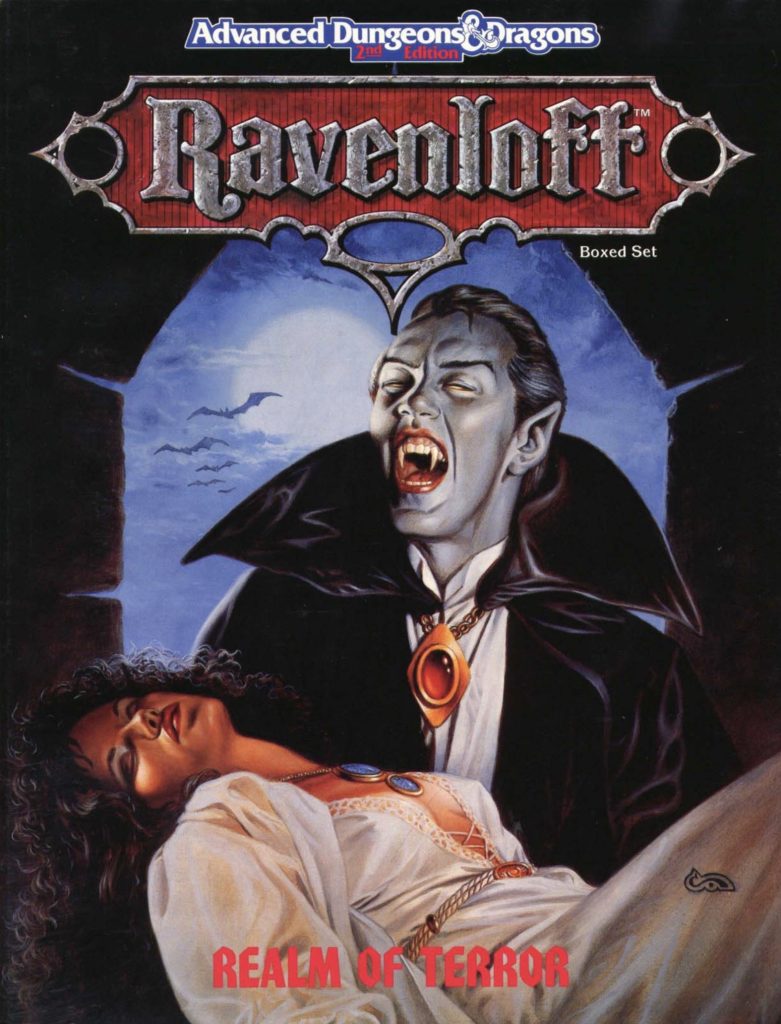
In June 1990, TSR published the Realm of Terror boxed set. The Black Box took the material of two adventures and turned it into a campaign setting. A 144-page rulebook. Four colour maps. Twenty-four cardstock sheets. Sixteen chapters covering everything from gothic atmosphere to altered spell lists to domain-by-domain gazetteering. It introduced the Demiplane of Dread, the Dark Powers, the domain-per-darklord structure across thirty-four domains, the powers check mechanic, the fear and horror check system, and the Barovian Calendar with 735 BC as the canonical present. Credits name Bruce Nesmith as game designer with Andria Hayday as “ghost” writer and additional designer. Special thanks go to Tracy and Laura Hickman “for TSR’s 1982 Ravenloft adventure, and all other spirits whose haunting suggestions and helpful comments have left a mark upon these pages.”
The design and writing credits belong to Nesmith and Hayday. The Hickmans are acknowledged, but the Black Box is not presented as a Hickman-designed product. Nesmith and Hayday worked from the published modules on their own reading of what they contained. What follows is a systematic account of what they did with the foundation, element by element, using the preserve-generalise-replace framework established in Part 1.
The Chapter Structure
Before examining what was preserved, generalised, or replaced, it is worth noting what the Black Box chose to lead with, because the ordering reveals priorities.
Chapter I, “From Gothic Roots,” is a three-page essay on the genre. It opens with the nature of Gothic horror, discusses landscape, setting, sensuality, dreams, and the powers of nature, and closes with a suggested reading list that runs from Shirley Jackson to Polidori. This chapter has no game mechanics. It is pure atmosphere. It is also, by placement and emphasis, the first thing the product tells you about what Ravenloft is.
Chapter II, “The Demiplane of Dread,” follows immediately with the cosmological framework: the Tome of Strahd, the growth of the demiplane, the timeline, the mists, gates, conjunctions, the domain structure, and the rules for forming new lands, waging war, and leaving Ravenloft. The cosmology comes second, after the mood.
Chapter III reshapes player characters. Chapter IV introduces fear and horror checks. Chapters V and VI handle werebeasts, vampires, and curses. Chapter VII covers the Vistani. Chapter VIII addresses fortune-telling. Chapters IX and X alter spells and magic items. Chapters XI and XII describe the Core domains and Islands of Terror respectively. Chapter XIII, “The Who’s Doomed of Ravenloft,” provides darklord and NPC profiles. Chapter XIV gives the Bloodlines genealogies. Chapter XV offers techniques of terror. Chapter XVI suggests adventure ideas. An appendix adds new monsters.
The ordering is itself an argument. Atmosphere first. Cosmology second. Mechanics third. The land and its inhabitants come late, after sixty pages of rules. The darklords come later still, after eighty. The product builds from mood outward, not from setting inward. This is consistent with what Appelcline records: that Nesmith and Hayday worked from the adventure’s atmosphere rather than from its material. The structure of the book enacts that choice.
What Was Preserved
A note on the category: preservation in the Black Box often means preservation of surface material under altered structural logic. What is retained in text or name is not always retained in function. The sections below mark the distinction where it matters.
The Tome of Strahd
The Black Box reproduces the Tome of Strahd on page 8, presented as excerpts from “an ancient journal, penned in the hand of Count Strahd Von Zarovich.” The text is recognisably the I6 Tome, covering Strahd’s settlement in Barovia, his jealousy of Sergei, his love for Tatyana, his pact with death, the murder of Sergei, Tatyana’s leap from the walls, and Strahd’s transformation. The language is close to the I6 original. The key beats are preserved: the warrior past, the ageing, the pact, the wedding-day murder, the thousand-foot fall through the mists, the arrows that pierced him but did not kill him.
The text is preserved. Its function is not. Placed at the opening of the cosmological chapter as the origin point of the setting, the same document that in I6 was a found handout now bears the weight of explaining why an entire demiplane exists. This is preservation in the letter and recontextualisation in the function.
Barovia
The Barovia domain entry on pages 63 to 65 preserves the village, the castle on its precipice, the Svalich woods, the Balinok mountains, Lake Zarovich, and the Old Svalich Road. The surface texture is continuous with I6, but the domain logic around it is altered: what was a single adventure’s setting is now a permanent domain within an artificial demiplane. The folk speak Balok, dress darkly, dread the night, bar their doors at sunset, and feel that their gods have abandoned them. The churches are in disrepair. Strahd rules as a tyrant whom the folk call “the devil Strahd,” though they believe this refers to his personality and not his species. The Vistani maintain a semi-permanent camp at the base of Castle Ravenloft. The entry preserves much of I6’s surface texture, even where the surrounding setting logic changes its meaning.
But the Black Box also adds to Barovia in ways that depart from I6. It introduces Strahd’s Choking Fog, a ring of poisonous vapour surrounding the village and castle that acts as a neutralised poison, draining Constitution from anyone who tries to leave without Strahd’s permission. This is the border-closing mechanism for Barovia. It is new. I6’s mists sealed the valley; the Choking Fog is a different device, specific to the domain, lethal in its operation. It turns Strahd’s border from an atmospheric barrier into a mechanical trap with hit-point consequences.
The entry also introduces Vallaki, a town of 1,500 on the southern shore of Lake Zarovich. Vallaki does not exist in I6. The boxed set populates Barovia beyond the village, giving it a second settlement of fishermen and farmers, with orchards of hardy apples and plums used to make brandywine tuika. This is worldbuilding that I6 did not do. The module gave a village. The setting gives a domain with geography, economy, and a second population centre.
The folk tale that “the gods hid a piece of the sun under Castle Ravenloft” and that “if it can be recovered and returned to the gods, Barovia will be forgiven and its curse lifted” appears in the Barovia entry. Most Barovians dismiss the legend entirely.
Mordent
The Mordent entry on pages 76 to 77 preserves Mordentshire, the House on Gryphon Hill, and the Weathermay estate (here called Heather House). The folk are fishermen, superstitious, polite, secretive. The Apparatus survives as local folklore: the Mordentish tell stories of “an alchemist in Mordentshire, who invented an Apparatus” that could “take the soul from any being and cast it into oblivion, or even implant it in another body.” Some say it separated good and evil in a man. Others say it was destroyed. Most natives believe the entire tale is fiction.
This is a careful preservation. The Apparatus, which was the central mechanism of I10, is retained as folklore within the domain. The product does not declare the Apparatus destroyed or fictional. It preserves the ambiguity. The folk do not know what happened. The DM is free to decide.
What changes is the darklord. I10’s central antagonist in Mordent was the Creature, who is the I10 manifestation of Strahd. The product promotes Lord Wilfred Godefroy, a ghost who already exists in I10 as the haunting presence of Gryphon Hill. In I10, Godefroy is backstory: magistrate records in the Mordentshire bookshop describe how, some four hundred years prior, he murdered his wife and child at the Gryphon Hill estate, and his remains lie in the pauper’s grave of the Weathermay mausoleum, where his ghost tries to possess visitors. His wife and child haunt the house itself. The Black Box takes this background figure, gives him the name “Lord Wilfred,” changes the child from a son to a daughter, and elevates him to darklord of the domain. Each night, the spirits of his wife and daughter hunt him down and tear at his incorporeal flesh.
This replacement solves the immediate structural problem. The Creature cannot be Mordent’s darklord in a setting where Strahd is already Barovia’s darklord, because the Creature is Strahd. But the replacement also reveals something about the Black Box’s method. Godefroy’s curse is tailored to his specific crime: he murdered his family, and his family haunts him nightly. He works the way darklord curses work in I6 and I10: the punishment answers the crime directly, at the scale of the individual. The full implications of that are taken up in the Mordent section below.
The Gothic Register
Chapter I, “From Gothic Roots,” is the Black Box’s most sustained engagement with the source material’s tone. The chapter discusses landscape, setting, the powers of nature, sensuality, seduction, and dreams. It identifies the genre’s key elements: that Gothic horror teases rather than shocks, that the settings are massive and gloomy, that nature is impartial and overwhelming, that sensuality pervades villain and victim alike, and that dreams blur the line between real and false. The chapter is well written. It demonstrates genuine understanding of the genre the modules drew from.
The suggested reading list is revealing. It names Jackson’s The Haunting of Hill House, Shelley’s Frankenstein, Stoker’s Dracula, Wells’s The Island of Dr. Moreau, Stevenson’s Dr. Jekyll and Mr. Hyde, Blackwood, Byron, Le Fanu, Lovecraft, Poe, Polidori, and Stoker again. This is a serious list. It shows that whoever compiled it (Nesmith credits Hayday with the “ghost” writing) had read the genre, not just the modules.
The atmospheric preservation is genuine and important. The product feels like Ravenloft. Whatever it does to the structural foundations, it never loses the mood. The atmosphere is the one part of the foundation the Black Box preserves with little structural damage.
The Vistani
The Vistani chapter (Chapter VII) takes the travelling clan from I6 and recasts them as the Vistani, extending the group into a setting-wide culture. The key move is structural. A setting of sealed domains needs someone who can cross borders, or it has no connective tissue. The boxed set makes the Vistani that someone. They travel the Mists freely, tell fortunes, and maintain pacts with domain lords. The Strahd-clan relationship, which in I6 was local and personal, is specified as a formal alliance: Madame Eva entered Barovia in 470 BC, struck a deal for mutual protection and intelligence, and received from Strahd the formula for the potion that counteracts the Choking Fog. In return, the Vistani inform Strahd of activities in other domains and act as his spies. This is a generalisation driven by the setting’s structural requirements. The travelling clan had a local role in I6. In the campaign setting they have a setting-wide function because the architecture demands it.
The chapter structure makes a further point. In I6, the clan and the reading are one dramatic act inside the adventure: the party meets Madam Eva, and the Fortunes are played. In the Black Box, Chapter VII covers the Vistani as a culture and Chapter VIII covers fortune-telling as a procedure. What the module kept as a single lived event, the setting divides into two chapters of infrastructure. That is a small but precise instance of what the Black Box does throughout: the reconfigurable drama of the modules becomes the administered machinery of a setting.
What Was Replaced
The Dark Powers
No chapter in the Black Box is titled “The Dark Powers.” No section defines them systematically. Yet their presence pervades the product, introduced obliquely through implication and scattered references across multiple chapters. How they accumulate authority is worth tracing.
The Tome of Strahd, as the Black Box presents it, mentions “a pact with death, a pact of blood” but does not name the Dark Powers. The editorial commentary that follows the Tome is where the replacement begins. It asks: “Was it a curse on Barovia or the castle itself? The work of the dark power (or powers) with whom Strahd made his pact? Or was it the rage and sorrow that followed, as Tatyana was lost and Strahd vented his torment by murdering all those within the castle walls? Perhaps it was all of these reasons; perhaps it was none.” The dark powers are named as one possible explanation among several, and then the entire setting is built on the assumption that they exist.
The “Growth of a Demiplane” section on page 9 establishes the mechanism. Azalin discovered that the demiplane “was alive. It did not breathe, as a creature does, or move, or mate, or eat. But it responded to the life within it. It could grow and change, and would create new earth for those whose evil or desire was strong enough to capture its attention.” The land itself responds to evil. New domains form when a creature of sufficient will and evil enters the Misty Border: “the Mists recede, and the land around him takes on a form and substance that reflect his basic nature.” This is not an external agency acting on the demiplane. It is the demiplane acting on its own, responding to evil as a quasi-organic process. The Dark Powers are not named as the agents of domain creation in this passage. The land itself does it.
The “Forming New Lands” section on page 12 develops this further. “Each domain reflects the personality and past offenses of its lord. It constantly reminds him of everything he was and is. He cannot escape those reminders, because every domain imprisons its lord.” And: “Lords are passionate creatures driven by a lust for power, remorse, a need for vengeance.” The domain-as-prison-and-mirror is established here.
But the Powers Check section (Chapter III, pages 17 to 20) makes the Dark Powers operational. “Ravenloft responds to evil. It even appears to nurture it, because when evil is strong, the land can trap it forever.” And: “If the dark powers of Ravenloft act, the response varies in intensity, from Stage One (the weakest) to Stage Six.” Stage Six is “Lord of a Domain”: the land grants the character a domain of his own, and “no player character can be a lord.” The powers check makes the Dark Powers the active, watchful, interventionist authority that the rest of the setting implies they are.
I6 and I10 do not present the Dark Powers as a governing cosmological authority. The cosmological structure of both modules is open. The campaign setting closes it with material that has no precedent in either module.
The Punishment Mechanism
In I6, Strahd’s punishment is personal. He is cursed for what he did to Sergei and Tatyana. The villagers live under his tyranny, but I6 does not present them as sharing Strahd’s curse or as enclosed by the same explained mechanism. They are people who live where they live.
Turn to the Barovia entry, and the picture is different. The population “bear the burden of Strahd’s yoke every day.” They are “reserved, and surly or gruff.” They “keep to themselves and don’t cause trouble, because troublemakers tend to end up dead, or worse.” They dread the night. They have abandoned their churches. “The people feel that their gods have abandoned them. The continuing evil of their tyrant lord and his routine slayings have led them to this belief.” The girls whose families advertise their availability for marriage by hanging wreaths of wildflowers on the door “usually disappeared.”
And the Choking Fog does not merely seal Barovia as I6’s mists did. It actively poisons anyone who tries to leave without permission. Strahd controls the fog. The population cannot leave. They are not merely governed but enclosed, and no passage in the Black Box distinguishes their condition from the lord’s curse, assigns them moral status, or explains the mechanism by which they came to share his imprisonment. The structure exists, uncommented upon.
The “Developing New Lords of Your Own” section in Chapter XIII confirms where the product’s attention falls. “The lords of Ravenloft are tortured souls. Despite their decidedly dark nature, most still have a tiny kernel of goodness. Some small part of them evokes our sympathy or pity.” The lords are to be sympathetic. Their domains are prisons tailored to their crimes. The populations within those domains are, by the logic of the text, incidental to the lord’s story.
The Tatyana Cycle
The Strahd entry in Chapter XIII states: “Through the years, there has always been one woman in Barovia who resembles her so closely that she could only be Tatyana’s reincarnation. Finding that woman, obtaining her, and winning her love is Strahd’s obsession.” The entry describes him as having “only two weaknesses”: his egotistical pride and “his eternal ‘love’ for Tatyana.” The scare quotes around “love” are the product’s own. Every few generations, a woman appears, Strahd pursues her, and loses her. “He can pursue her, but can never hold her. The land ensures his eternal torment.”
I6’s Fortunes mechanism made Tatyana one of four possible goals. The campaign setting makes it the only one. In the module, a DM could draw a configuration where Strahd is not pursuing Tatyana at all, where his attention is on the Sunsword or the Sphere of Darkness or a new identity. The product commits to the Tatyana cycle as canonical and discards the other three configurations.
The Timeline
The timeline on page 9 is not a preservation of existing chronology. It is an imposition of fixed dates on material that I6 left undated. The module provides sequence, names, and duration, but not calendar years. The Black Box supplies those years itself: 351 BC for Strahd’s transformation, 542 for Azalin’s arrival in Barovia, 579 for Mordent’s entry into Ravenloft, and 735 BC for the setting’s canonical present.
That act of fixing dates immediately produces a contradiction with the module the chronology is supposed to regularise. If Strahd’s transformation occurred in 351 and the present is 735, then only 384 years have passed. But I6’s burgomaster’s letter says Strahd has drained the land “for over 400 years,” and the optional ending is labelled “After 500 years, Tatyana and Sergei reunited.” The Black Box’s chronology therefore fails against I6’s own internal time-markers. It does not merely add dates. It assigns dates that do not fit the source.
Later products worsened the problem rather than solving it. Domains of Dread placed I6’s events at 528 BC, which leaves only 177 years between Strahd’s transformation in 351 and the adventure’s present. That is irreconcilable with either “over 400 years” or “after 500 years.” The chronology was unstable from the moment Ravenloft ceased to be a reconfigurable scenario and became a dated setting line.
The Bloodlines
The Bloodlines chapter (Chapter XIV) provides genealogies for eight families: the Von Zaroviches, the Boritsis, the D’Honaires, the Dilisnyas, the Drakovs, the Reniers, the Timothys, and the Weathermays. Each family tree gives birth and death dates, marriages, and notes on mysteries and cross-references.
The Von Zarovich tree is the most important for this analysis. Problems become visible when it is read against I6’s crypts, which contain the entire ruling circle: King Barov, Queen Raven, the First Counsellor Stephan Gregorovich (Crypt 25), the court wizard Khazan (Crypt 15), and Duchess Dorfniya Dilisnya (Crypt 8), all dead in or around the same period.
The Bloodlines give Barov and Ravenia death dates of 346, five years before the wedding massacre. The Dilisnya tree shows Dorfniya (289–340) married to Pidlwik Dilisnya (280–349) but does not show her Von Zarovich parentage, though I6’s crypt gives her the title Duchess and her naming pattern suggests royal birth. The designers appear to have read the crypts as separate deaths rather than as evidence of a single catastrophe that killed the entire court. The Bloodlines attempt to stabilise what I6 left variable. They are interpretation rather than preservation, and the interpretation does not hold against its own dates.
Below Sturm, the tree truncates twelve generations with no names or dates, covering 248 years (from Sturm’s line in the 380s to Anna Von Zarovich, born 630). That is a quarter of a millennium of blank genealogy in the ruling family of the setting’s central domain. The chapter’s own introduction acknowledges the gaps: “Some branches indicate a descendent, but the name and dates are missing.” It frames these as mysteries for the DM to fill. In practice, they are the consequence of fixing a family history that the module never established and the designers did not have enough material to complete.
The Dilisnya tree introduces its own problems, beginning with a foundational misreading of I6. Crypt 8 holds “Duchess Dorfniya Dilisnya.” Crypt 9 holds “Pidlwik (Fool of Dorfniya).” In I6, “Fool” means jester, court fool. Pidlwik was Dorfniya’s entertainer. The RoT Dilisnya tree makes Pidlwik Dilisnya (280–349) her husband, reading “Fool of Dorfniya” as a marital relationship rather than a professional one. This is the single most consequential misreading in the Bloodlines, because it determines the entire shape of the Dilisnya family tree: Pidlwik becomes the patriarch, the family descends from him, and Dorfniya becomes his wife rather than the royal figure whose jester he was. Dorfniya’s title of Duchess ties her to royalty regardless, and the text supports the simpler reading that the designers read two adjacent crypts and inferred a marriage where the module gives a duchess and her fool.
Note A on the Dilisnya tree reads: “All deaths in 351 occurred at Castle Ravenloft, the day of Tatyana’s wedding.” The tree shows Reinhold Dilisnya (310–351) among the family members dying on the same day. Cross-referencing this with the Von Zarovich tree and I6’s crypts produces a picture consistent with two closely allied families (or one family under two names) whose entire senior membership was killed in the same event. The Bloodlines treat this as background colour. Read against I6, it suggests a massacre on a scale the Black Box does not otherwise acknowledge. The Boritsi, Renier, Von Zarovich, and Dilisnya trees all cross-reference each other through shared figures and dates, forming a web of canonical values in which any error propagates through every tree it touches.
Reconfigurability
The timeline fixes dates. The maps fix borders. The domain entries fix populations, encounter tables, and darklord identities. The Bloodlines fix family histories. The Strahd entry fixes his motivation as the Tatyana pursuit. The Fortunes mechanism is not referenced. The Dreams of Barovia appendix from I10 is not referenced. The cosmological openness of I10, which offered three valid interpretations of the Barovia-Mordent relationship, is replaced by a single cosmology: both are domains within the Demiplane of Dread, governed by the Dark Powers, positioned on a map with fixed borders. Across the product, the design principle that Part 1 identified as the modules’ most distinctive contribution is absent.
Throughout, the product proceeds as if the foundation were a conventional setting source rather than a pattern designed for variation. The consequences of this choice will accumulate across the product line. They are taken up in the closing section of this piece and in the essays that follow.
The Powers Check
The powers check mechanic deserves separate treatment because it is the Black Box’s most distinctive mechanical innovation and the one that most directly expresses the replacement punishment mechanism in gameplay.
The framing text is explicit. “Ravenloft responds to evil. It even appears to nurture it, because when evil is strong, the land can trap it forever. This could happen to a player character. The AD&D game is designed for heroes, but despite the best intentions of the DM and all guidelines to the contrary, some people insist on playing the opposite. These players, if not careful, may find their characters gradually wrested from their control.”
The mechanic operates through six stages. Stage One, “The Enticement,” rewards the character with minor gifts: a few extra hit points, the ability to see in darkness, small fangs. Stage Two, “The Invitation,” escalates to minor magic items and abilities like detect invisibility or charm person. Stage Three, “The Touch of Darkness,” grants minor powers with physical changes. Stage Four, “The Embrace,” gives significant abilities (fly at will, shape-change, raise dead by touch) while the character begins losing control of his actions. Stage Five, “Creature of Ravenloft,” splits the character’s mind into two personalities; the dark side takes over for days at a time, run by the DM. Stage Six, “Lord of a Domain,” makes the character an NPC darklord with a tiny domain of his own.
Each stage pairs a reward with a punishment. The rewards are mechanical: hit points, abilities, powers. The punishments are physical and social: evil odour, glowing eyes, forked tongue, animal fur, tentacle fingers, mandatory blood-drinking. The design intent is that the rewards tempt while the punishments mark. The character becomes more powerful and more monstrous simultaneously.
This mechanic makes the Dark Powers operational at the table. They are not distant or indirect. They observe every evil act. They respond with tailored gifts and curses. The theological structure this implies is active, interventionist, and omnipresent. Every evil act in the Demiplane of Dread is potentially observed and answered by the governing cosmological authority.
In I6, no authority intervenes to punish Strahd in real time. His imprisonment is a condition. The adventurers resolve the situation through mortal action. In I10, the Alchemist’s choice at the cliff edge is a mortal choice. No dark power watches and responds. The powers check replaces mortal-scale resolution with cosmological-scale surveillance.
The Fear and Horror Checks
The fear and horror check system (Chapter IV) is the Black Box’s other major mechanical innovation, and it deserves brief notice because it works differently from the powers check in a way that illuminates the product’s relationship with its source material.
Fear checks respond to immediate physical threats. Horror checks respond to revulsion, anguish, and the realisation that something is fundamentally wrong with the world. The distinction is sharp: fear is what you feel when a monster can kill you; horror is what you feel when you see a maiden remove her head at a pool.
These checks are not connected to the Dark Powers. They are psychological mechanics, saving throws against the emotional impact of the setting. They operate at the human scale. A character who fails a horror check is not being punished by a cosmological authority. He is reacting as a human being would react to something terrible. Where the powers check makes every evil act a transaction with an omnipresent governing force, the horror check simply asks what it costs a person to see something genuinely terrible. That is the scale I6 and I10 work at, and it is the only place the Black Box consistently stays there.
What Mordent Tells Us
The Mordent entry and the Godefroy profile together illustrate the Black Box’s method more clearly than any other single domain, because Mordent is the one domain where the designers had a complete foundation to work from, and they chose to replace nearly all of it.
I10 established Mordent as a place with its own internal logic. The Creature was the I10 manifestation of Strahd. The Apparatus was a mortal invention. The resolution was mortal-scale. The cosmological relationship between Barovia and Mordent was left open across three valid interpretations. And I10 had its own major antagonist beyond the Creature: Azalin, an 18th-level lich residing in the Weathermay family mausoleum, presented on page 45 of the module as “the Creature’s most powerful, and least trusted, ally.” Azalin was the biggest single villain in I10 after the Creature himself. He was already in Mordent, already powerful, already complex in his motivations. He was the most obvious figure the setting designers could have elevated once Mordent needed a domain lord.
Azalin does not become lord of Mordent. Instead, the Creature is replaced by Lord Wilfred Godefroy, a ghost who already haunts Gryphon Hill in I10 but is a background figure there, not a lord or antagonist. The Black Box promotes him to darklord, gives him a fuller backstory (he murdered his wife and daughter, was haunted by their spirits, and committed suicide), and makes him lord of Mordent when Strahd and Azalin departed. Azalin is instead given his own domain, Darkon, the largest in the setting, with a retconned backstory that has him entering Barovia through the Mists in 542, serving as Strahd’s unwilling ally, and eventually leaving Barovia to create Darkon through sheer force of personality. (The Azalin entry says he “walked into Strahd’s choking fog,” but the Choking Fog as described in the Barovia entry is the poisonous ring around the village and castle, not the Misty Border that surrounds the domain. The product appears to confuse its own mechanisms.)
The retcon is visible in the dates. The timeline says Mordent enters Ravenloft in 579. The Godefroy entry says that “Strahd Von Zarovich and Azalin came to Mordentshire, and Mordent became part of Ravenloft.” The Strahd entry confirms: “In time, Azalin and Strahd found passage to Mordent, where an alchemist was experimenting with a magical apparatus.” Azalin’s presence in Mordent is framed as part of a joint Strahd-Azalin escape attempt from Barovia. But in I10, Azalin is already in Mordent independently. He is not a visitor from Barovia. He is a resident of the Weathermay mausoleum who was discovered by the Creature “soon after his arrival in this area.” I10 does not explain how Azalin got to Mordent. It does not need to. He is simply there.
The retcon extends to memory. Azalin’s I10 presence in Mordent is retrofitted into the Strahd-Azalin escape narrative, and then the characters’ memories are fogged: “Neither Strahd nor Azalin can remember what happened to them in Mordent; it is like a misty dream to them now.” The dreams framework from I10 is preserved, but inverted. In I10, the cosmological relationship between Barovia and Mordent is dreamlike by design: three valid interpretations, none privileged. In the Black Box, the characters’ memories are dreamlike as a plot device to prevent the events of I10 from being reconstructed within the setting’s own continuity. The openness becomes a gap in the characters’ knowledge rather than a feature of the setting’s design.
The Apparatus survives as folklore. The Mordentish tell stories of “an alchemist in Mordentshire, who invented an Apparatus” that could “take the soul from any being and cast it into oblivion, or even implant it in another body.” Some say it separated good and evil in a man. Others say it was destroyed. Most natives believe the entire tale is fiction. The Black Box does not declare the Apparatus destroyed or fictional. It preserves the ambiguity. But by giving Mordent to Godefroy rather than to Azalin or the Creature, it sidelines the Apparatus from having any structural role in the setting. The Apparatus becomes colour rather than mechanism.
The Weathermay family tree (page 128) fixes Godefroy’s crime chronologically. Note C reads: “Lord Godefroy murdered his wife and daughter in 578. Their spirits haunted him, and he committed suicide one year later. He became the ghost-lord of Mordent in 579.” This creates another contradiction with I10. The magistrate records in I10’s Mordentshire bookshop describe the murder as having occurred some four hundred years before the adventure’s events. The Bloodlines place it one year before Mordent entered Ravenloft. The designers appear to have missed I10’s own dating when they fixed the Weathermay tree.
Godefroy’s punishment is nonetheless specific and contained: he murdered his family, and his family haunts him nightly. His curse answers his crime directly, without implicating anyone else. The irony is that Godefroy works well as a darklord precisely because his curse operates the way curses do in the modules. But he was a background ghost in I10, promoted over Azalin, who was the adventure’s most prominent villain after the Creature and who was already established as the most powerful independent figure in Mordent.
What Azalin Tells Us
The Mordent section showed what the Black Box did to a domain when it had a complete foundation to work from. Azalin shows the same method from the other side: not what happened to the place, but what happened to a pre-existing villain once the designers decided that place needed a different lord.
Azalin does not originate in the Black Box. He originates in I10. The Masters of Mordentshire section on page 45 presents him as an 18th-level lich, alignment Neutral (Evil), residing in the Weathermay family mausoleum. He is “the Creature’s most powerful, and least trusted, ally.” He does not trust Strahd, is more concerned with preserving his own decaying body than with helping the vampire, and will retreat rather than fight to the death. He has a quasit familiar named Tintantilus.
I10 gives Azalin no backstory beyond his presence in Mordent and his alliance with the Creature. The campaign setting takes this bare sketch and builds from it. The Azalin entry in Chapter XIII gives him a pre-Ravenloft history: he was “a powerful wizard king of men, although he was known by another name,” who became a lich, ruled and tormented his subjects, was driven out by mercenaries, fled into a fog-cloaked glen, and was carried into Barovia by the Mists. This is new material, not preservation or generalisation. The backstory is a replacement for I10’s silence.
Azalin’s curse is specific and personal: “He can never rise above the experience level he now holds. And he can never learn more magic than he now knows. Even if presented with a scroll and tutored in the use of new spells upon it, he cannot learn them. Magical information, even not related to spells, seems to slip through his mind like dust through a net.” He desires power above all else, and Ravenloft gave him tremendous power but paralysed it. He cannot grow. He cannot learn. He bears “the pain of knowing that he once grasped that information” whenever new knowledge escapes him.
Azalin’s curse works the way Strahd’s does in I6: tailored to the specific sin, operating at the scale of the individual, with the population of Darkon incidental rather than instrumental. The same holds for Godefroy. The strongest darklords in the product are the ones whose curses answer their crimes directly. The setting’s broader architecture runs on a different logic entirely.
What the Domains Tell Us
Part 1 closed with Appelcline’s record of what Nesmith and Hayday concluded when they read I6: that Barovia was “not really suited for a campaign” and did not offer enough flexibility or variety. Part 1 argued that this conclusion missed what the modules actually offered: a pattern-based design that could support many campaigns, not one canonical narrative.
The domain roster of the Black Box makes the designers’ actual intent visible. They were not trying to generalise I6 into a setting. They were building a Gothic horror anthology.
Falkovnia is Vlad the Impaler: a mercenary king whose brutal militia controls the domain, who demands at least one execution each night at the dinner hour, and who impales as many as forty people on special evenings while an orchestra plays. Lamordia is Frankenstein: a domain whose darklord is a mad surgeon named Adam Mordenheim, creator of a flesh golem called simply “the monster.” Darkon is the wizard-tyrant: a lich ruling the largest domain in the setting through a secret police called the Kargat. Markovia is The Island of Doctor Moreau: a mad surgeon who transforms humans into beast men through surgery and hormonal injections, without anaesthesia. Borca is the Borgias: a domain ruled by a poisoner who murdered her husband and his mistress. Richemulot is the wererat domain. Kartakass is the domain of the wolfwere bard. Each domain is a different Gothic or horror set-piece, drawn from a different corner of the genre’s literary tradition.
The suggested reading list in Chapter I confirms this. Jackson, Shelley, Stoker, Wells, Stevenson, Poe, Le Fanu, Polidori, Lovecraft. The domains are the reading list made playable, drawing on the full breadth of the genre rather than on the specific material of the two modules.
This is a legitimate creative choice. It produced a rich and varied setting. But it is not the choice the modules invited. The modules established a pattern: central antagonist in a specific place, mortal instrument, configurable resolution. That pattern could have been generalised to produce a setting in which every domain worked the way Barovia and Mordent work, with internal logic, punishment that answers the crime, and the DM free to interpret the cosmology. Instead, the designers chose to populate the map with literary archetypes, each requiring its own origin story, its own punishment, its own population of collateral inhabitants. The domain-per-darklord structure needed an explanation for why all these disparate horrors coexist in one place. The Dark Powers are that explanation. The collective punishment framework is the price of the anthology model. If every domain is a separate gothic tale, someone has to be the author imposing the tales, and the populations within them become the author’s set dressing.
The primary source does not support that conclusion in the form Nesmith and Hayday gave it. The modules offer a template, not a narrative, and a template can be instantiated as many times as a DM has players. What the template could not support is the specific kind of setting the designers wanted to build: a continent of thirty-four domains, each instantiating a different Gothic horror archetype. For that project, the modules’ material was indeed insufficient. But the insufficiency was in the scope of the designers’ ambition, not in the foundation itself. They chose the anthology model in place of the scalable grammar the modules already supplied. What Appelcline records them seeing as a narrow adventure was, structurally, a portable form. The Black Box replaced it with something larger and more varied, and in doing so replaced the logic that made it work.
What the Black Box Built
The preceding sections may read as a bill of indictment. They are not intended as one. The Black Box solved real problems. It turned two adventures into a campaign setting. It provided DMs with a cosmology they could use, a map they could populate, mechanics they could run, and an atmosphere they could sustain across a campaign. The “From Gothic Roots” chapter is a genuinely useful essay on the genre. The “Techniques of Terror” chapter gives practical DMing advice that holds up thirty-five years later. The “Developing New Lords” section offers a strong template for creating darklords. The fear and horror checks brought psychological mechanics into AD&D for the first time in an official product. The Vistani chapter built a culture that, for all the problems later products would create with its real-world parallels, gave the setting necessary connective tissue.
The product won the Origins Award for best graphic presentation. It launched a line that ran for fifteen years across three editions. Whatever it did to the foundation, it worked as a commercial and creative product.
The question this series asks is not whether the Black Box is good. The question is whether it is faithful to its foundation, and where it departs, what the consequences of those departures are.
The departures are architectural, not incidental, and the anthology decision named in the Domains section is their root. That root decision required the Dark Powers, required fixed parameters, and produced the collective punishment framework as a structural consequence. In solving the problem of how to make Ravenloft into a setting, RoT replaced the modules’ governing logic with a different one. The detail errors in the Bloodlines and timeline are downstream of that root. They are what happens when a reconfigurable foundation is forced into canonical fixity by designers who were solving a different problem from the one the foundation posed.
The question for the rest of this series is what the products that followed did with these choices, and whether any of them found ways to work within the replacement architecture without losing what I6 and I10 had built.
What Comes Next
The Black Box is the hinge. Everything published before it is foundation. Everything published after it inherits its choices.
The immediate successors include the Darklords supplement of 1991, the Van Richten’s Guides, Christie Golden’s Vampire of the Mists, and I, Strahd: The Memoirs of a Vampire. Each inherits the Black Box’s architecture. This series will not cover every product in the line. It will follow the thread where it matters: tracing what the replacement framework produced, and whether anything in the product line found ways to work within it without losing what I6 and I10 had built. The next piece in the series takes up the first of those questions.
Bibliography
I6 Ravenloft, Tracy and Laura Hickman, TSR Inc., 1983.
I10 Ravenloft II: The House on Gryphon Hill, design team working from an outline by Tracy and Laura Hickman; David Cook, Jeff Grubb, Harold Johnson, and Douglas Niles, TSR Inc., 1986.
Realm of Terror (Ravenloft Campaign Setting), Bruce Nesmith with Andria Hayday, TSR Inc., 1990.
Shannon Appelcline, Designers & Dragons, Evil Hat Productions, 2014, and the product histories reproduced on DriveThruRPG.
John W. Mangrum, Fraternity of Shadows wiki. Consulted via archive.
Discussion
Thoughts, opinions, feedback — all welcome. First-time contributors will be held briefly for review.
No thoughts yet. Be the first.