I6, I10, and the Foundation the Black Box Inherited.
The Ravenloft setting most readers know begins with the 1990 Realm of Terror boxset: the Demiplane of Dread, the Dark Powers, the domains, the darklords, and the 735 BC framework. But that boxset did not create Ravenloft from nothing. It inherited two prior modules: I6 Ravenloft in 1983 and I10 Ravenloft II: The House on Gryphon Hill in 1986.
This piece, and the articles that follow it, read the Ravenloft primary sources against what later products made of them. The method is source-criticism in the strict sense: separating what I6 and I10 actually establish from what later products add, alter, or replace. Part 1 stops before the Black Box opens, asking what Ravenloft already was before it became a campaign setting.
The observation that the Black Box departed from the modules is not original to this series. Shannon Appelcline’s published history of the Ravenloft line documents the decision Nesmith and Hayday made in 1989: that Barovia as I6 established it was too narrow for a setting, and that the creators chose to build new structure around the adventure’s atmosphere rather than to work from its material. John Mangrum, who later contributed to the 3e gazetteers, wrote on the Fraternity of Shadows wiki that “Realm of Terror started Ravenloft’s long-standing tradition of incoherence.” Anonymous contributors to the Wizards Community noted in the 2000s that the Dark Powers framework was absent from I6 because it did not yet exist at the time the module was written, and that Tatyana’s punishment differed structurally from the incidental suffering of the villagers. The tradition has recognised parts of the problem for decades. This piece treats those fragments systematically: naming the structural shift from personal to collective punishment as the central change RoT imposed, and tracing where that change leads.
The Design Principle
The shared design principle of I6 and I10 is reconfigurability. I6 varies the adventure through the Fortunes: Strahd’s goal, the location of three key items, his starting position, and his combat advantages all change from run to run. The four goals are distinct. Each configuration is a different adventure. The module names none as canonical. It says run the cards and substitute the results.
I10 applies the same principle to cosmology. The Dreams of Barovia appendix offers three valid interpretations of how Barovia and Mordentshire relate, and the adventure ends with “The End?” — a question mark, not a full stop. The cosmological relationship is configurable in the same way the adventure parameters are.
Together, the modules define Ravenloft less as a fixed setting than as a repeatable pattern. Certain constants remain, while specific facts become parameters.
I6 does not present reconfigurability as a purely hidden procedure. The card reading is staged in play through Madam Eva and the travelling clan the module calls gypsies. That matters. The Fortunes are not merely a prep table but a social ritual inside the adventure, performed by a group that brings the party to the valley’s edge, conducts the reading, and operates under terms with Strahd that neither the villagers nor ordinary travellers share. In I6, reconfigurability is not only mechanical. It is dramatised.
Preserve, Generalise, or Replace
Any later product working from these two modules faced a choice for each element it inherited. The element could be preserved at adventure scale, generalised across a larger scale, or replaced with something new.
Preservation keeps the element as given. The cost is inconsistency: an element that worked in one adventure may not extend to the rest of the line.
Generalisation extends the element by abstracting it. The cost is flattening: what was specific becomes generic.
Replacement removes the element and puts something new in its place. The new element is not in the foundation. Whether it respects the foundation or departs from it depends on what it is.
These three options are the lens through which the subsequent pieces examine what TSR did with I6 and I10. Part 2 will show that RoT’s choices concentrated heavily on replacement.
What I6 Establishes
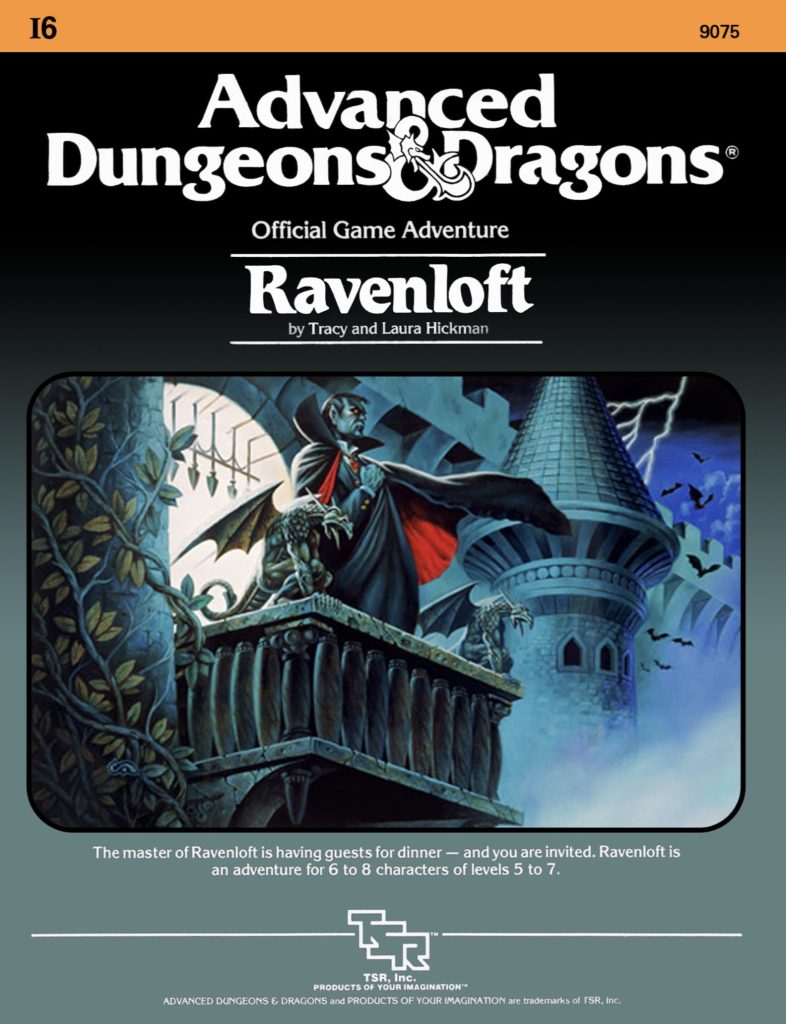
The Fortunes give Strahd four possible goals. Only one has him pursuing the current Tatyana-return. The others have his attention elsewhere: seeking a new identity, assembling the sphere of darkness, or destroying the Sunsword. Three of the four configurations have nothing to do with Tatyana at all. The draw can be repeated during play.
The travelling clan also carries part of the module’s threshold logic. They bring the party toward Barovia, host the reading, and move through the valley under a special relationship to Strahd that distinguishes them from both villagers and ordinary outsiders.
The optional ending, in which Sergei appears, establishes a connection between Ireena and Tatyana and makes clear that the tragedy has played out across “many centuries”: “Through these many centuries we have played out the tragedy of our lives.” The cycle can end, and the optional ending describes this.
Specific named villagers bear specific costs. Mad Mary is broken by the loss of her daughter Gertruda. Kolyan Indirovich writes the burgomaster’s letter that brings the adventurers and dies before they arrive. Strahd has been in the valley for centuries. The adventure’s present is not specifically dated.
Goal, item locations, Strahd’s position, the year — all left open. What is constant is the pattern: vampire, valley, tragedy, sealed fog, and the optional ending in which Tatyana and Sergei can be reunited.
What the Primary Corpus Permits
Beyond its direct claims, I6 supports a layer of interpretation that the reconfigurability frame invites. The module does not spell out a theological mechanism for the reincarnation cycle, name what authority governs the punishment, or specify the moral status of the villagers relative to Strahd’s condition. These questions are left open.
What the careful reader can assemble is a mechanism of personal scale. The tragedy turns on what Strahd did to Sergei and Tatyana, and the punishment is structured around that history. The villagers suffer from the condition of the valley, sometimes directly and severely, but the module does not frame the community itself as the thing under judgment.
This is interpretation, permitted but not compelled, with full development belonging in the source-critical essays on I6 itself. What matters here is that the foundation carries a punishment mechanism centred on individual guilt. Whether that can be scaled to a setting is the question the rest of the piece takes up.
What I10 Adds
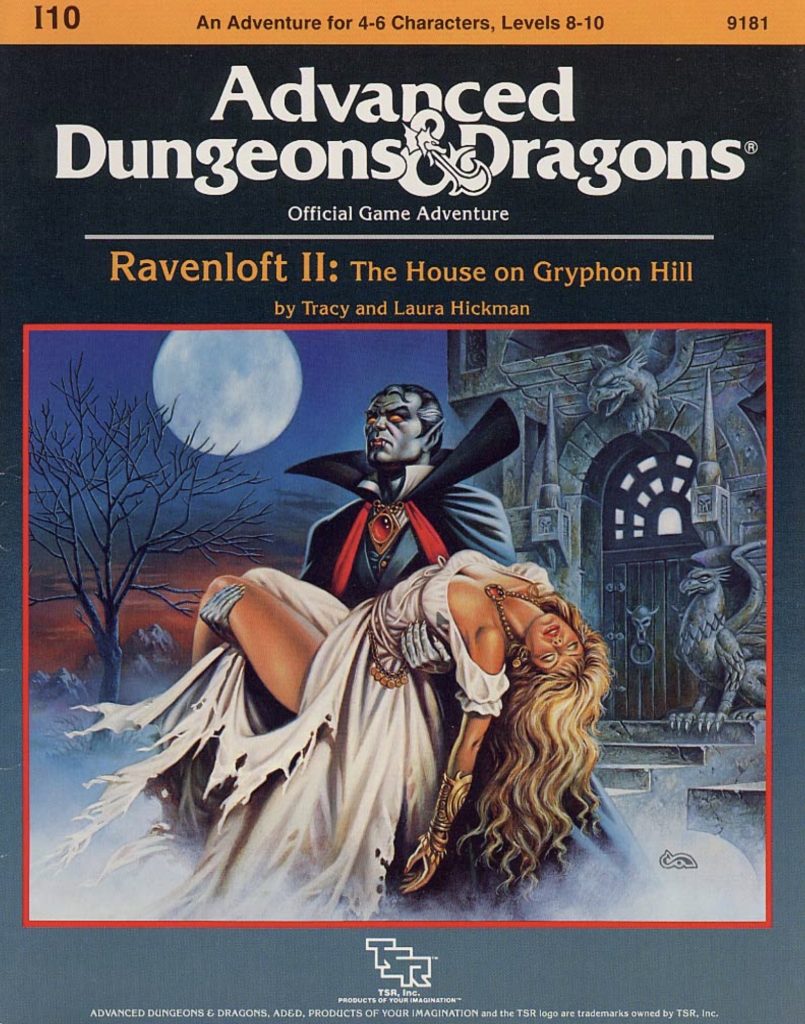
I10 was written by a design team working from an outline by Tracy and Laura Hickman, published in 1986. It is routinely described as a sequel. It is not. The Peculiar History Part 2 piece works through the evidence in detail.
I10 extends reconfigurability from adventure to cosmology. Where I6 establishes that adventure parameters are configurable within a constant pattern, I10 establishes that the cosmological relationship between its setting and I6’s is configurable within a shared structure. The Dreams of Barovia appendix names three valid interpretations. The adventure ends with “The End?”
The Apparatus that drives I10 is an internal mechanism. Built by a mortal, activated by a mortal, operating through effects the primary corpus does not require external cosmological agents to explain. The catastrophe is mortal-scale. The resolution is mortal-scale. The cliff-edge lunge by the Alchemist is a mortal choice. No god intervenes. No dark power rescues.
I10 also demonstrates that the pattern is portable. Mordent is not Barovia. The Creature is not the I6 Strahd. The local geography, the cast of characters, the specific threat, and the resolution mechanism all differ. The structural pattern survives the transplant intact: a central antagonist in a specific place, a mortal instrument, a conflict that resolves through mortal choice, a setting that leaves its cosmological grounding configurable. Two different instantiations of the pattern existed and worked between 1983 and 1986. The pattern did not require Barovia to function.
I10 also introduces, as a fully present figure rather than a late addition, a second major villain independent of Strahd: Azalin, an 18th-level lich lodged in the Weathermay mausoleum, described as the Creature’s most powerful and least trusted ally. By 1986, the foundation already contained more than one significant antagonist. What later designers inherited was not a one-villain pattern but a pattern that had already demonstrated capacity for a second.
The cosmological openness of I10 is not an oversight. The Dreams of Barovia appendix names three valid interpretations and commits to none of them. The adventure ends with “The End?” rather than “The End.” This is a design choice, not a gap: the module declines to settle what it could have settled. That deliberate refusal to fix cosmological parameters is the design logic that later products would have to either preserve or replace.
What was not scalable, or at least what would not scale without being changed, is what the rest of this piece takes up.
Why These Two Are the Bibles
I6 and I10 are the bibles of Ravenloft not because later publishers treated them as sacred, but because between them they already define the things every later Ravenloft product has to answer.
I6 is not merely the first Ravenloft module. It establishes the core adventure grammar of the line: sealed landscape, central antagonist, mortal intruders, variable configuration, tragedy at the centre, and a resolution that is not fixed in advance. It designs Ravenloft as a repeatable form rather than a single fixed story.
I6 could still be dismissed as a brilliant one-off. I10 prevents that dismissal. It carries the same underlying structure into a different place, with a different cast, a different immediate mechanism, and an explicitly open cosmology. Once I10 exists, Ravenloft is no longer just the Barovia module. It is a form that works elsewhere, a pattern that does not require Strahd or his valley to function.
Together, the two modules do not merely begin the line. They define the inherited problem of Ravenloft. Every later product either preserves their logic, generalises it, or replaces it. That is the sense in which they are normative: not because anyone decreed them authoritative, but because they contain the line’s design grammar before the line knows it has one.
What the Designers Inherited
When Bruce Nesmith and Andria Hayday sat down to design the Realm of Terror boxset for a June 1990 launch, the material available was two modules. Between 1986 and 1990, TSR had published nothing else set in Ravenloft. Christie Golden was working on Vampire of the Mists in parallel, but it did not reach print until September 1991, fifteen months after the Black Box launched. The Hickmans themselves were not involved. Nesmith and Hayday worked from the published modules on their own.
It is a small foundation, built without the authors of the foundation. What the designers did with those two adventures determined what Ravenloft would become.
Some elements scaled naturally. The pattern of a central antagonist in a specific place was already present in two instances: Strahd in Barovia, the Creature in Mordent. A continent of domains, each with its own such figure, is a natural extension. The reconfigurability principle was similarly scalable. The gothic horror register was available without modification.
Other elements did not scale. The Tatyana mechanism was specific to Strahd. A reincarnation cycle operating as personal punishment for a specific murder against a specific bride does not generalise without being preserved at adventure scale or abstracted into something less specific. Each choice has a cost. Whatever governs the punishment in I6 operates coherently within a single adventure without needing to be named or systematised. It does not obviously become a setting cosmology without expansion or replacement. The cosmological openness of I10 is not a cosmology at all. Three valid interpretations is a refusal to commit. A setting needs something a DM can work with.
Appelcline records Nesmith and Hayday’s own account of their reasoning. They concluded that I6’s Barovia was “not really suited for a campaign” and did not offer enough flexibility or variety. They opted instead to work from the adventure’s atmosphere rather than from its material. They did not see in I6 the reconfigurability this piece names. They saw a narrow adventure that would not support a setting at scale. Their solution was to build new structure.
What the Foundations Established
By 1990, the foundation was small but coherent. Two modules, three years apart. I6 gave the form: sealed landscape, central antagonist, mortal intruders, variable configuration, tragedy at the centre, resolution not fixed in advance. I10 proved the form was portable: different place, different cast, different immediate mechanism, explicitly open cosmology, the same underlying structure intact. Together they established a punishment mechanism centred on individual guilt, though its effects are not confined to the guilty, and a design principle of reconfigurability that makes each element a variable rather than a fixed fact.
That is what makes I6 and I10 the bibles of Ravenloft. They do not merely come first. They define the structural conditions every subsequent Ravenloft product either works within or departs from. Later material may be larger, louder, and more systematised, but it is answering problems these two modules had already posed. The Black Box was the first product to depart from them significantly. Part 2 traces those departures, element by element.
Bibliography
I6 Ravenloft, Tracy and Laura Hickman, TSR Inc., 1983.
I10 Ravenloft II: The House on Gryphon Hill, design team working from an outline by Tracy and Laura Hickman; David Cook, Jeff Grubb, Harold Johnson, and Douglas Niles, TSR Inc., 1986.
Vampire of the Mists, Christie Golden, TSR Inc., 1991. (Prologue specifically. The novel’s main narrative inherits later framing and is not primary corpus.)
Realm of Terror (Ravenloft Campaign Setting), Bruce Nesmith with Andria Hayday, TSR Inc., 1990.
Shannon Appelcline, Designers & Dragons, Evil Hat Productions, 2014, and the product histories reproduced on DriveThruRPG.
Discussion
Thoughts, opinions, feedback — all welcome. First-time contributors will be held briefly for review.
No thoughts yet. Be the first.